The Munro House Files
Episode Three: Why I Never Give a Client One Concept
The Munro House Files is a client series following a real renovation from the very beginning, the stuck feeling, the first conversation, and every decision in between. Start from the beginning with Episode One | Read Episode Two
When I came back to Deirdre with the floor plan options, I brought three. Not one. Not five. Three.
This is deliberate, and it matters more than it sounds.
What one concept does to a client
When a designer comes back with a single concept, they've already made the decision. The client's job becomes approval or the awkward position of saying no to something the designer is presumably confident in.
That's a lot of pressure to put on someone who hired you precisely because they weren't sure what to do.
And it produces a particular kind of paralysis. Not the paralysis of too many choices the paralysis of not being sure whether you actually like the thing in front of you, or whether you just don't want to seem difficult.
Deirdre had experienced this firsthand before she found FTLO. A previous designer had left months between sessions with no real progress. The decisions never accumulated into anything. The project sat still.
"There were six-month gaps between catchups," she told me at offboarding. "Nothing was moving."
That's not a pace problem. That's a structure problem. And structure is exactly what the three-concept method is designed to provide.
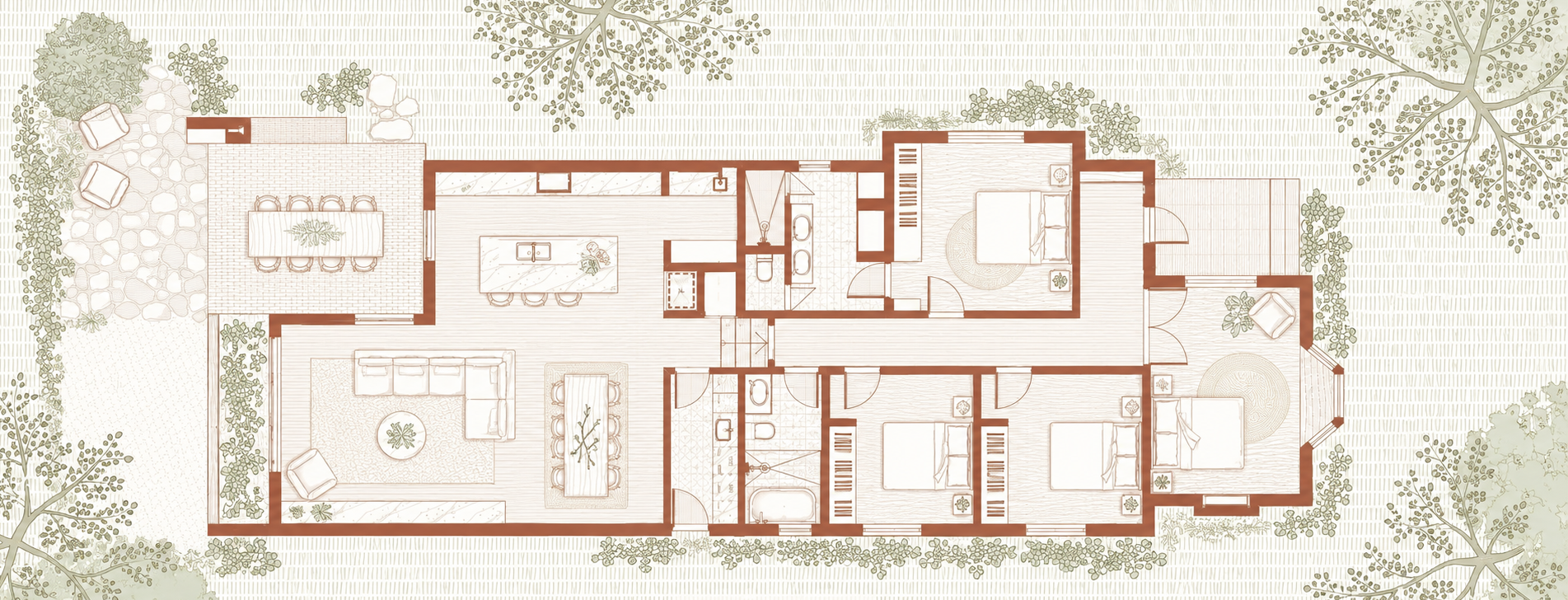
Munro House - Floor Plan Review - Option 1 (Keep reading to see Option 2)
Why I offer two and she chose three
Three concepts give a client something to react to rather than something to approve.
Each one represents a genuine position a different answer to the same brief. One might prioritise openness and connection to the garden. Another might separate the zones differently. A third might challenge an assumption in the brief entirely.
The client doesn't need to arrive certain. They just need to respond. And that response is more useful than almost anything else in the process.
With Deirdre, she came into the review session thinking she knew which concept she'd choose. She'd looked at the options beforehand and had a preference already forming.
She chose a different one.
Not because she was wrong about what she wanted but because seeing the three side by side, talking through the trade-offs, she realised the thing she cared most about wasn't what she'd thought. The view from the kitchen bench mattered more than the extra internal floor space. One concept gave her that. And once she saw it clearly, the decision wasn't difficult at all.
"She asked specific questions, came back with three concepts, walked us through pros and cons," Deirdre said. "We made a decision. Then she took us to the next step. And the next."
That last part is the thing. The decision didn't just resolve the floor plan it created momentum. Every stage that followed had something to build from.
The moment it became real
Before working with FTLO, Deirdre and her husband had been having the same renovation conversation for years. Different consultants, different quotes, nothing that ever landed in a clear direction.
"We had an idea of what we wanted, but we kept getting stuck on the same two things , how the spaces would actually flow, and how to land the interior decisions."
The three-concept review was the first time those two things had an answer at the same time.
Once the floor plan was decided, the exterior concept followed. Then the interior, space by space. What had felt like a sprawling, impossible project started to feel like a sequence of manageable decisions.
"Every stage felt led but it still felt like ours."
That's the balance I'm always trying to hold. The structure should carry the client, not override them.
The concepts give direction; the client gives the final word. Done right, they leave the session feeling like they made the decision because they did.
What happens when you get to a decision that holds
Deirdre described the moment the concept was confirmed as the point the project became real not a theoretical conversation about what the house might be, but a specific plan for what it was going to become.
The design language established in that floor plan review flowed naturally into every space that followed. The kitchen came first, as it almost always does once you know how the kitchen sits, how it orients, how it connects to the outdoor area, the rest of the plan starts to organise itself around that anchor.
"Renders enabled family decision-making," she noted meaning the concepts weren't just useful in the session. They were something she could take home, show her husband, share with family. The decisions became legible to everyone involved in the project, not just the people in the room.
That's the other thing three concepts does. It produces something you can share. Not a description of what might happen, but a picture of what's been decided.
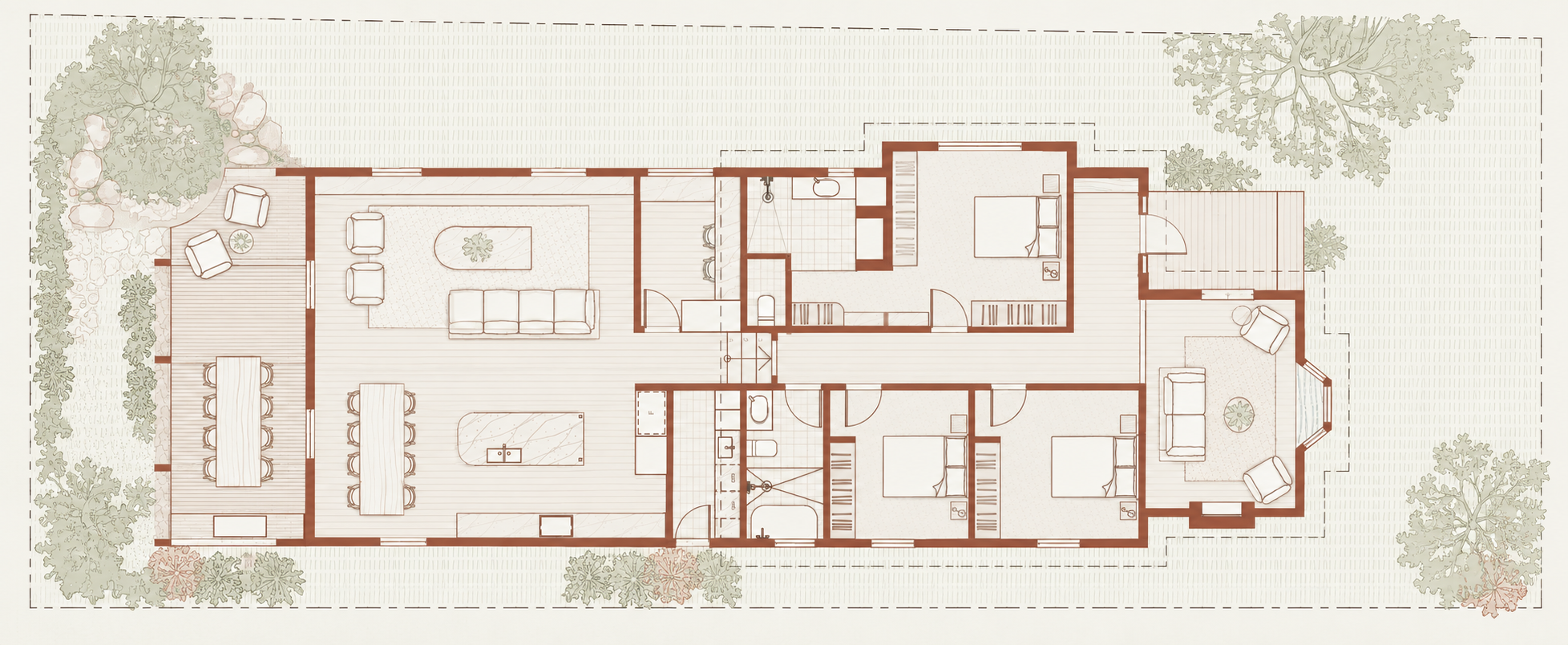
Munro House - Floor Plan Review - Option 2
Up next
Episode Four is about delivery, specifically, why I send a video walkthrough instead of a written report, and why Deirdre watched hers twice.
The second time with her husband, after the kids were in bed.
Ready to see three concepts for your own house?
The Floor Plan Review is $899. Two floor plan options and a video walkthrough of every decision.
Seven business days from your Zoom.
Book a Floor Plan Review → fortheloveofdesign.com.au/service/floor-plan-review
